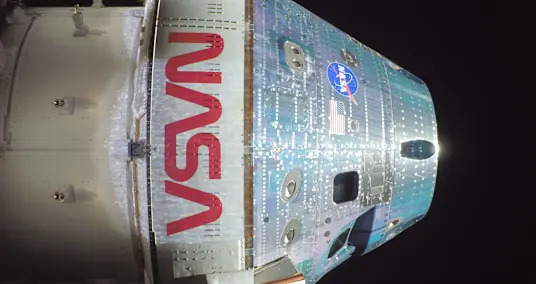
Artemis II live updates: NASA's historic moon mission set to make lunar flyby today

NASA’s Artemis II — the first crewed moon mission in more than half a century — is set to make its historic lunar flyby on Monday afternoon.

The four-member crew — NASA commander Reid Wiseman, pilot Victor Glover, mission specialist Christina Koch and Canadian space agency mission specialist Jeremy Hansen — entered the so-called lunar sphere of influence early Monday morning. The seven-hour flyby is scheduled to begin around 1:30 p.m. ET.

During their trip around the far side of the moon, they will surpass the record for the farthest distance from Earth traveled by humans, set by Apollo 13 at 248,655 statute miles.

The Artemis II astronauts will take photos and make observations from the Orion spacecraft, which is expected to lose contact with mission control for about 40 minutes as it passes behind the moon. The crew members will also witness a solar eclipse.

The Orion will then be officially on its way back to Earth. The 10-day mission is due to conclude on Friday, when Artemis II makes its reentry before a splashdown in the Pacific Ocean off the coast of San Diego.

Follow the latest updates on the Artemis II lunar flyby in the blog below.

Live3 updates
    • Dylan Stableford
      Dylan Stableford

      What NASA wants the crew to observe on the moon during their lunar flyby

      A screenshot of the Artemis II lunar science observation plan.
      A screenshot of the Artemis II lunar science observation plan.
      (NASA)

      As the Artemis II astronauts were preparing for their historic moon flyby, mission control in Houston sent the crew a final list of "lunar surface features" that NASA’s science team wants observed and photographed:

      The 30 targets include the Orientale basin, a nearly 600-mile-wide crater that straddles the Moon’s near and far sides. Orientale will be fully illuminated and visible as Orion approaches the Moon. This 3.8-billion-year-old crater formed when a large object struck the lunar surface and retains clear evidence of that collision, including dramatic topography in its rings. The crew will study Orientale’s features up close and from multiple angles as they pass by.

      Hertzsprung basin also is on the crew’s list of targets. Northwest of Orientale is a nearly 400-mile crater on the Moon’s far side. An older ringed basin, Hertzsprung offers a unique contrast to Orientale because its features have been degraded by subsequent impacts. The crew will compare the topography of the two craters to gain insight into how features evolve over geologic timescales.

      The lunar observations are scheduled to begin at 2:45 p.m. ET, per NASA.

    • Kate Murphy
      Kate Murphy

      A timeline of today's lunar flyby, including when a new record will be set for the farthest humans have ever traveled from Earth

      NASA provided the following timeline of what to expect during the Artemis II lunar flyby mission on Monday:

      • 1:30 p.m. ET: NASA will host a conversation between the Artemis II crew members aboard the Orion spacecraft and the mission’s science officer at the agency’s Johnson Space Center in Houston, to review the objectives and final timeline for the flyby.

      • 1:56 p.m. ET: The Artemis II astronauts are expected to set a new record for the farthest humans have ever traveled from Earth, surpassing the previous record set by the Apollo 13 crew, who traveled 248,655 miles from Earth in 1970.

      • 2:10 p.m. ET: The crew is expected to make remarks on setting the record.

      • 2:45 p.m. ET: The 7-hour lunar observation period starts when the crew will see the near and far sides of the moon.

      • 6:44 p.m. ET: The crew is expected to temporarily lose communication with mission control as the Orion spacecraft passes behind the moon.

      • 7:02 p.m. ET: The astronauts will make their closest approach to the moon, 4,070 miles away.

      • 7:07 p.m. ET: The Artemis II crew will reach its furthest point from Earth at a maximum distance of 252,760 miles.

      • 7:25 p.m. ET: NASA is expected to regain communication with the astronauts.

      • 9:20 p.m. ET: The flyby observation period concludes and the astronauts will start to transfer some of the lunar images to Earth. NASA will review the images overnight and speak with the crew about their experience on Tuesday.

    • Kate Murphy
      Kate Murphy

      The main goals of the Artemis II mission

      In this image from video provided by NASA, Artemis II astronauts, from left, Reid Wiseman, Jeremy Hansen, Christina Koch and Victor Glover gather for an interview en route to the moon.
      Artemis II astronauts, from left, Reid Wiseman, Jeremy Hansen, Christina Koch and Victor Glover en route to the moon on April 4. (NASA via AP)
      (ASSOCIATED PRESS)

      NASA’s central goal of the Artemis II lunar flyby mission is to test a crewed flight in lunar space — not to have them land on the moon. Main additional goals include:

      • The crew will need to validate the Orion spacecraft’s systems necessary to support astronauts in deep-space exploration.

      • NASA researchers will evaluate how deep space travel affects the human body, mind and behavior in order to help build future protocols to help protect astronauts on future deep space missions.

      • The crew will test Orion's handling capabilities and its Crew Survival System to protect the astronauts throughout all mission phases.

      • Study the performance of the Space Launch System rocket and the Orion space capsule at various stages of the mission, including launch, all the way to reentry to Earth.

      • The mission is a step toward long-term sustainable human lunar exploration and future missions to Mars.

    Share this article